

Every bulk purchase of bathroom vanities carries a ledger that is never printed on the quotation. The unit price is the number that gets negotiated and signed. The real cost lives in the years after installation — in replaced drawers, chipped countertops, disputed containers, and the awkward conversation with a client who expected the specification to still hold true on the day of handover.
Ask anyone who has supplied a 300-room hotel or a 2,000-unit residential tower. Failures rarely appear at the port. They appear eighteen months later, in a hot and humid bathroom, when a drawer stops closing and nobody can find the original supplier who promised it would not. The buyer absorbs the freight, the labour, the hotel’s downtime, and a piece of their own credibility.
That is the context in which SSWW bathroom vanities should be read. Not as a catalogue of features, but as five measured answers to the five things that most often go wrong in volume supply: formaldehyde emission levels compliance, countertop breakage, coating failure, drawer wear, and surface corrosion.

Start with the cabinet body, because it is the part nobody inspects and everybody later blames. SSWW cabinets are built from premium multi-layer solid wood plywood rather than low-grade particleboard, and the construction is certified to European E1 grade. What matters more for a tender package is the measured number: laboratory testing puts formaldehyde emission at just 6% of the national standard limit. In practical terms this means the product does not merely pass the threshold — it sits far inside it, with margin left for the variation that real production always carries.
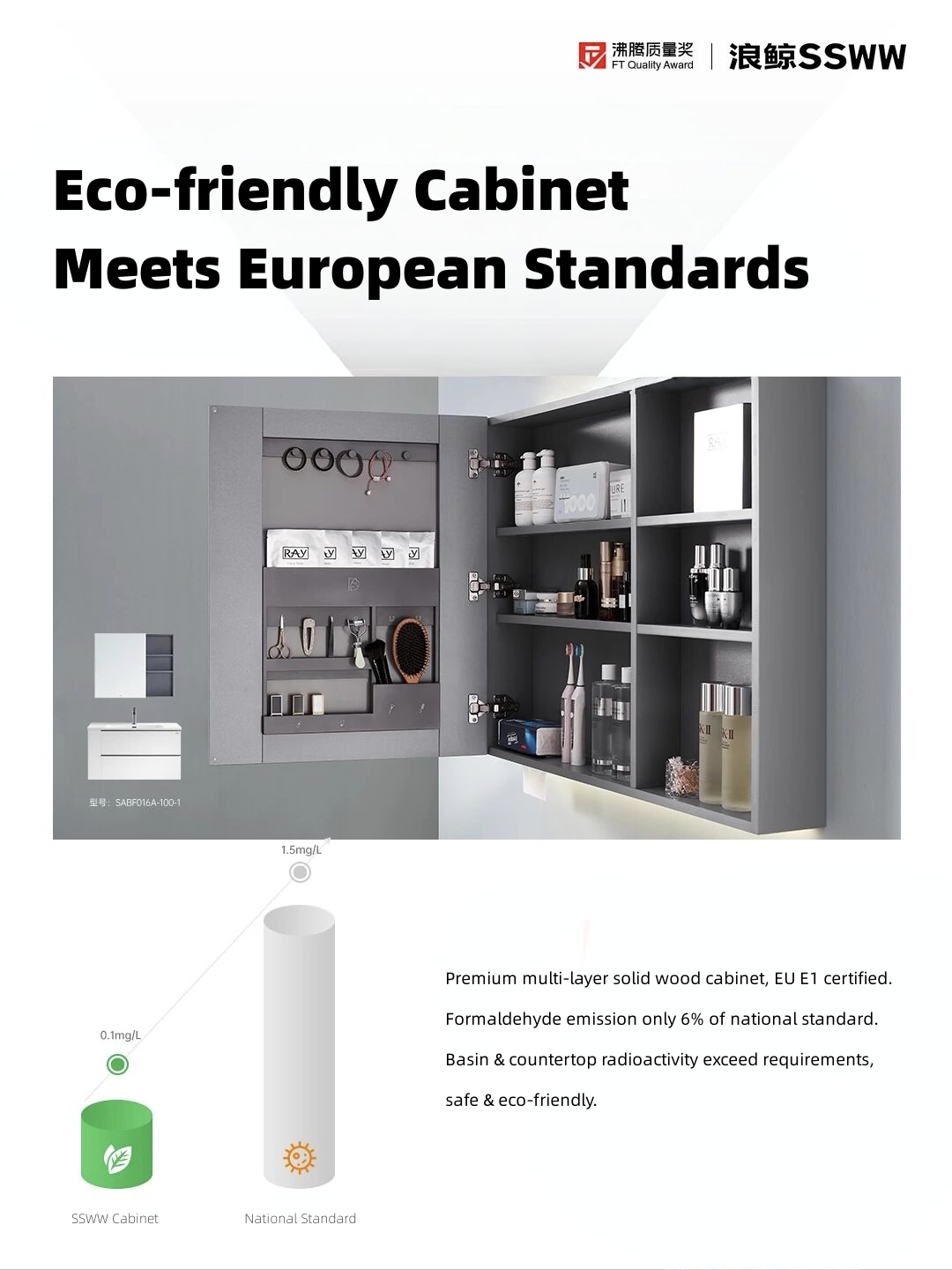
The basin and countertop have been tested for radioactivity as well, and both come in below the required limits. For projects where the buyer must submit health and safety documentation — schools, hospitals, serviced apartments, government housing — this is the difference between a specification that clears review and one that returns with questions attached. Compliance is not a marketing line here; it is a document you can hand over.
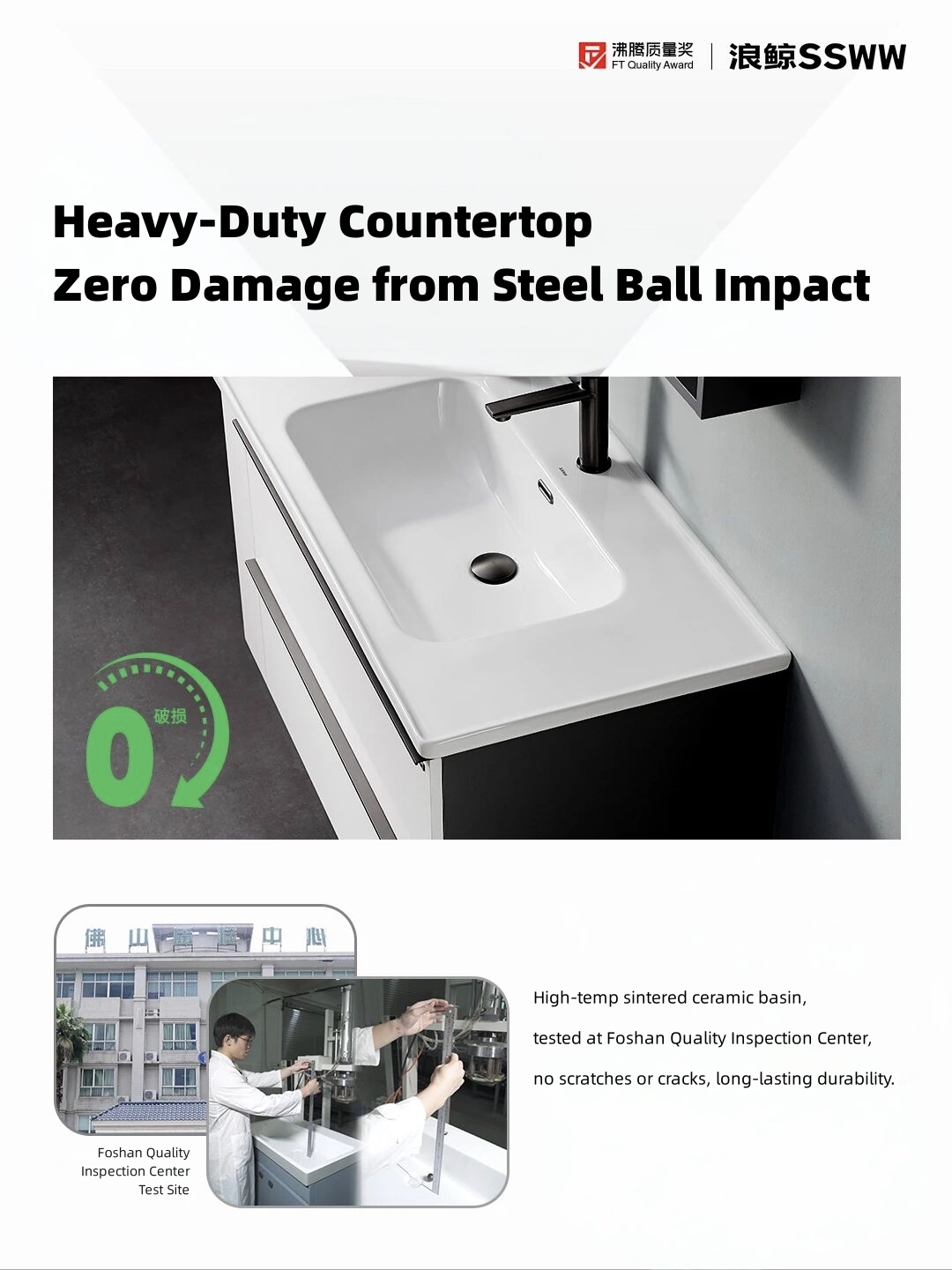
Countertop breakage is the second recurring loss in bulk supply, and it usually happens before the product ever reaches a guest. High-density die-cast forming and high-temperature sintering give the integrated ceramic basin and top a tighter, denser body than press-formed alternatives. In testing carried out at the Foshan Quality Inspection Institute laboratory, a steel ball was driven into the countertop surface, and the surface came away with no damage and no cracks. Read that as a shipping and installation argument: the impact that chips a weaker top in a container, on a loading dock, or under a plumber’s wrench simply does not register on this one.
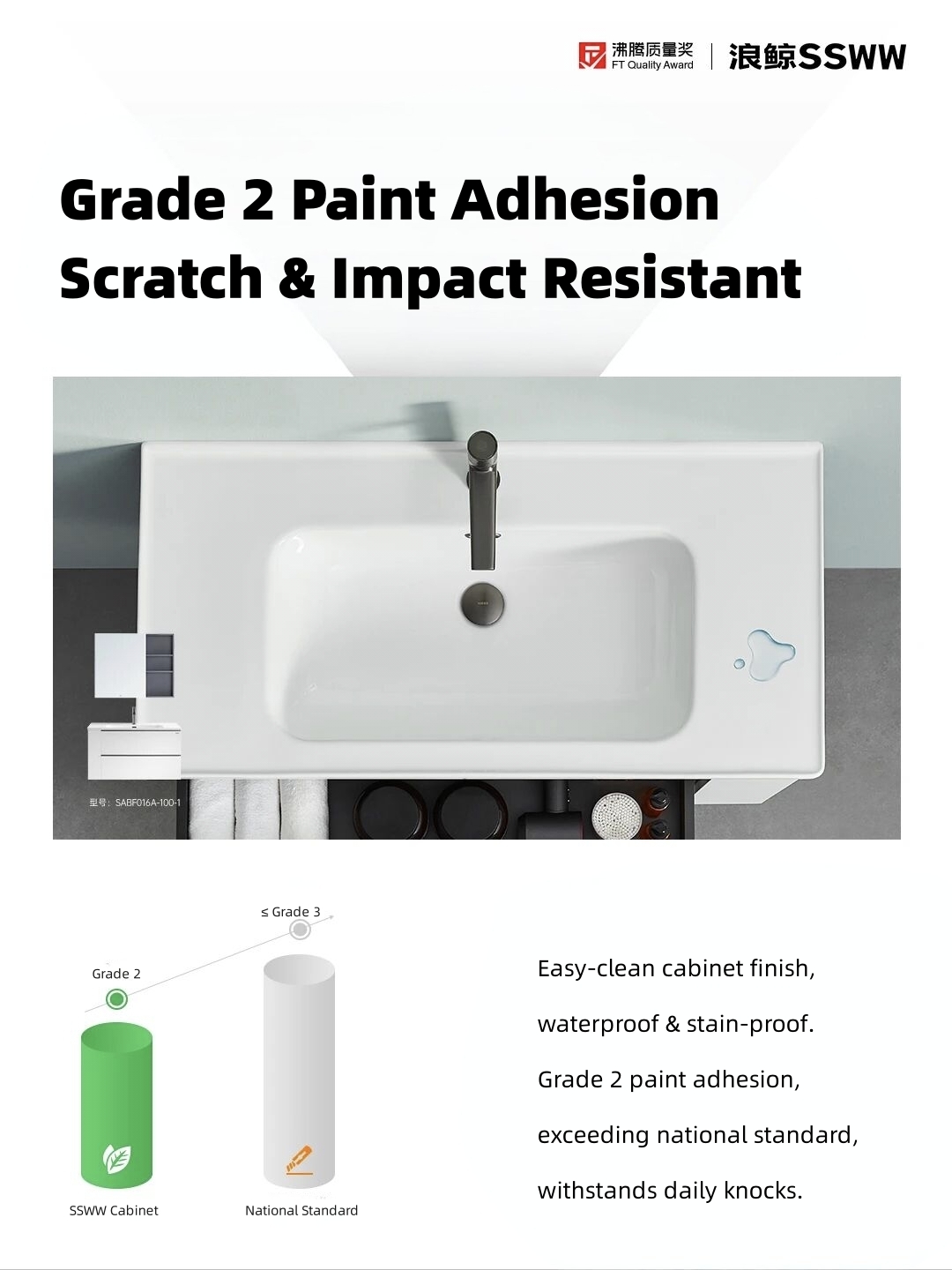
Coatings are where value quietly disappears. SSWW cabinet bodies use an easy-clean paint system that resists water and stains, and the film adhesion is rated Grade 2 — a result that outperforms the national standard requirement of Grade 3 or better on the same scale. For the buyer, the useful translation is that knocks, cleaning trolleys, luggage carts and daily housekeeping traffic do not open the surface up. A coating that holds is a coating that does not need to be re-specified on the second order.
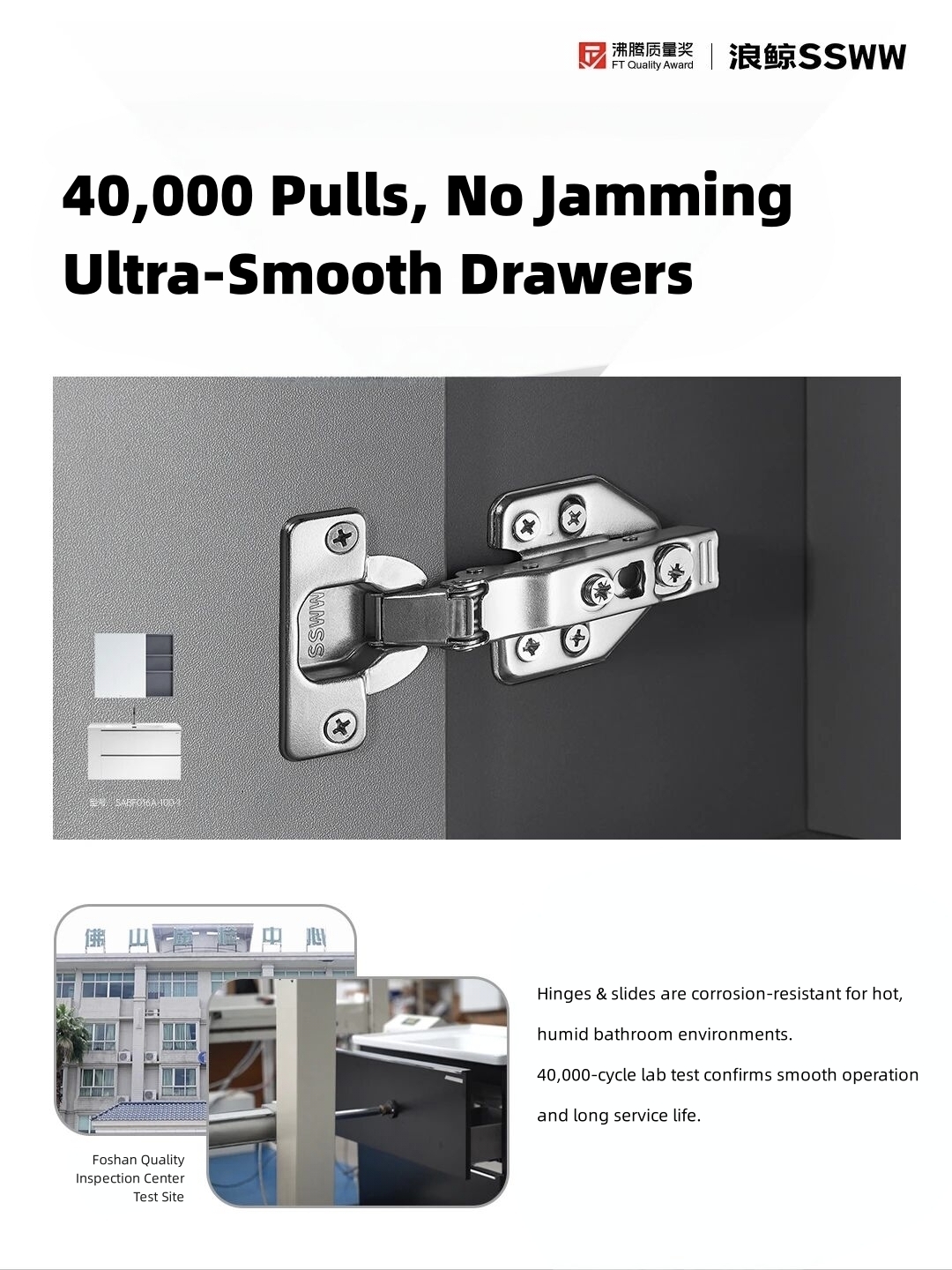
The drawer is the component that decides whether a property’s maintenance team remembers the supplier fondly. Bathroom cabinets live in permanent heat and humidity, so the durability and corrosion resistance of slides and hinges matter more than any showroom impression. SSWW drawers were run through a 40,000-cycle pull test in the laboratory, and the slides operated smoothly throughout with no jamming. Forty thousand pulls is not an abstract figure; it is years of daily use across a busy washroom block, compressed into a bench test.
The last failure mode is chemical, and it is the one facility managers complain about most. Cleaning crews use whatever the chemical supplier delivers — chlorine-based sanitizers, descalers, alkaline degreasers. In corrosion and staining tests using a range of chemical reagents, the SSWW basin showed no corrosive staining and no trace of surface damage. The surface stays bright and intact, which is exactly what a buyer is paying for when the specification says the bathroom must still look new in year five.
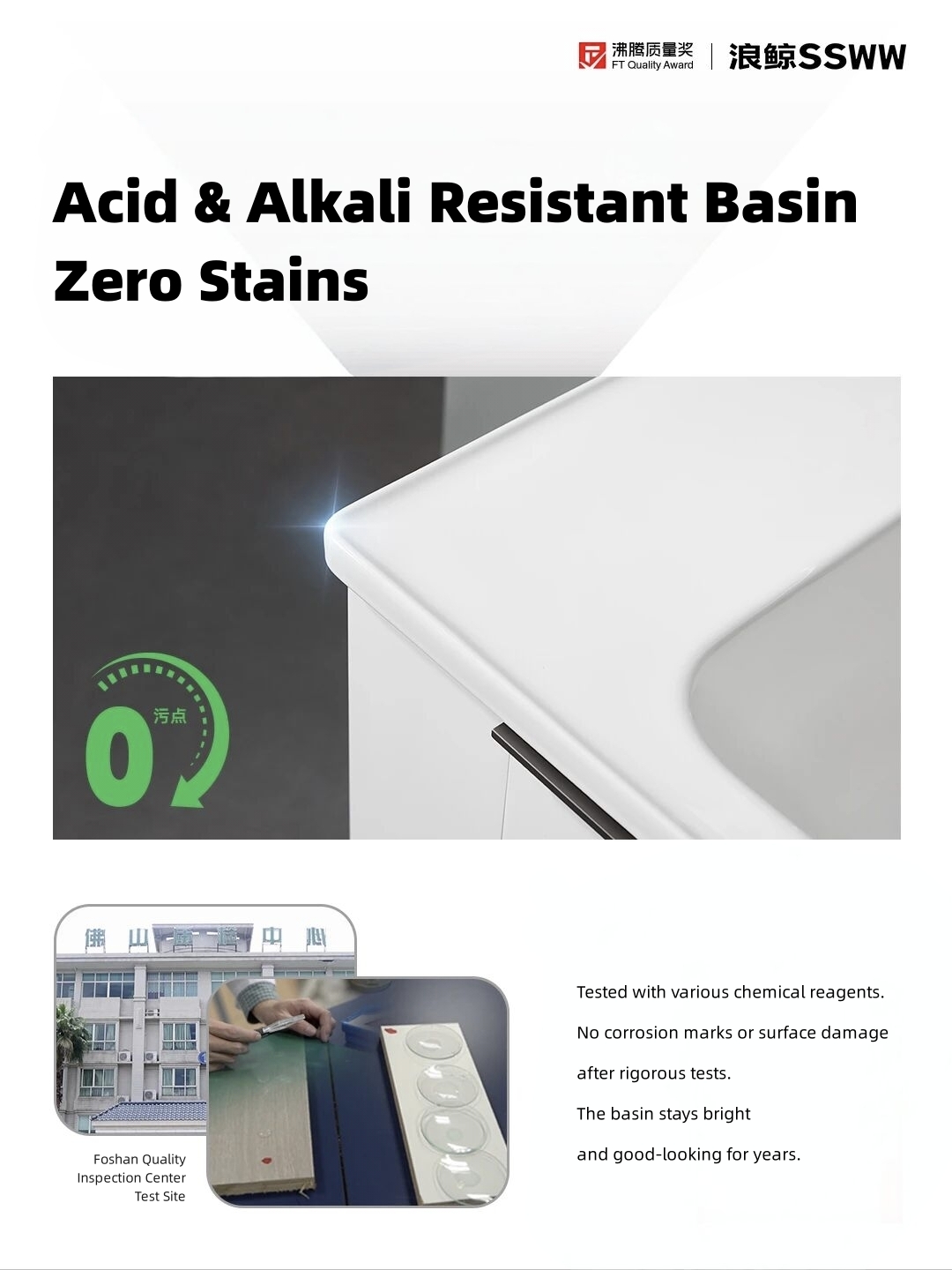
Put these five together and the commercial arithmetic becomes clear. A bulk buyer is not purchasing a vanity; they are purchasing a defect rate, a claim rate, and the number of site visits their own team will have to fund. Every one of these five test results removes a category of after-sales cost — replacement freight, hotel room downtime, rework labour, and the margin that quietly vanishes when a client withholds payment over a batch that failed inspection.
That is why SSWW is positioned as a supply partner rather than a line item. Full container programmes, OEM and ODM support for house brands, stable specifications across repeat orders, and test documentation that travels with the goods into tender reviews. For wholesalers, contractors, project procurement teams and private-label bathroom brands working across Africa, the Middle East, Southeast Asia, South America and Central Asia, the question is rarely whether a vanity is cheap enough. It is whether the container you receive in March will still be defensible in the warranty period three years later.
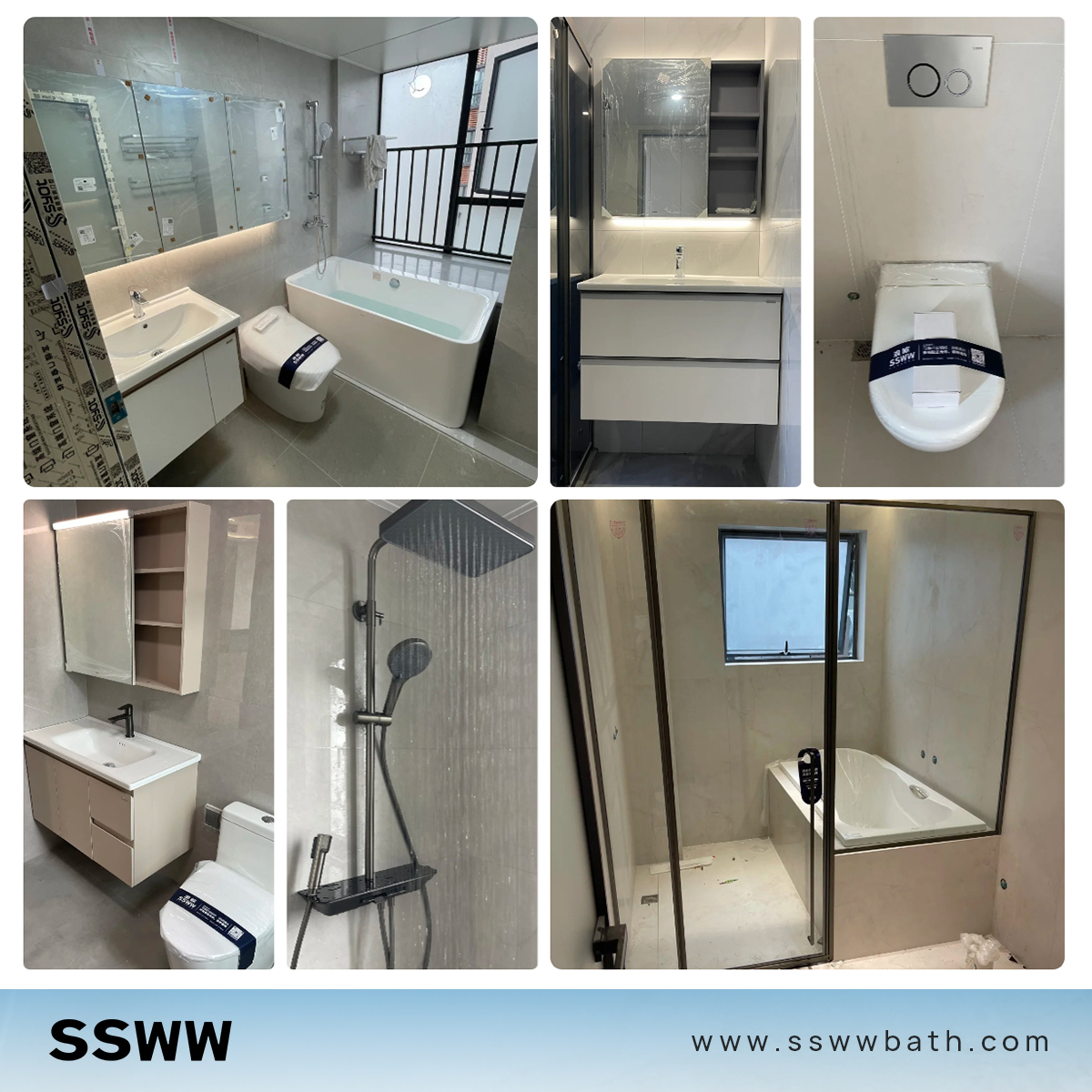
SSWW bathroom vanities are built to answer that question with paper, not adjectives.
Post time: Nov-19-2026


